History of Fossil Preparation
The paleontologists of the olden days are pretty much exactly how you would’ve imagined: gruff, outdoor adventurers who explored the American wilderness on horseback in search of bits and pieces of bone to assemble back together. By the late 19th century, methods of preparation advanced as interest grew in wealthy, urban areas for natural history museums.
Museums scrambled to add large display specimens to their catalogs, leading to fierce competition among paleontologists and their respective institutions. The infamous Bone Wars between Edward Drinker Cope of the Academy of Natural Sciences and Othniel Charles Marsh of the Peabody Museum of Natural History eventually bankrupted both men, but also contributed to some of the greatest advancements in understanding dinosaurs. The public’s interest in dinosaurs largely comes from what can best be described as a brief period of paleontological nuclear armament coinciding with the American Gilded Age.
During this time, paleontological institutions standardized their methods of documentation, storage, and preparation, employing hundreds of staff to manage their facilities. Early paleontologists used modified dental tools, hammers and chisels, and brushes to uncover the large vertebrate bones that they collected on expeditions to Kansas, Montana, the Dakotas, and California. Although their methods were crude, they were largely sufficient in preparing the large bones for display and study.
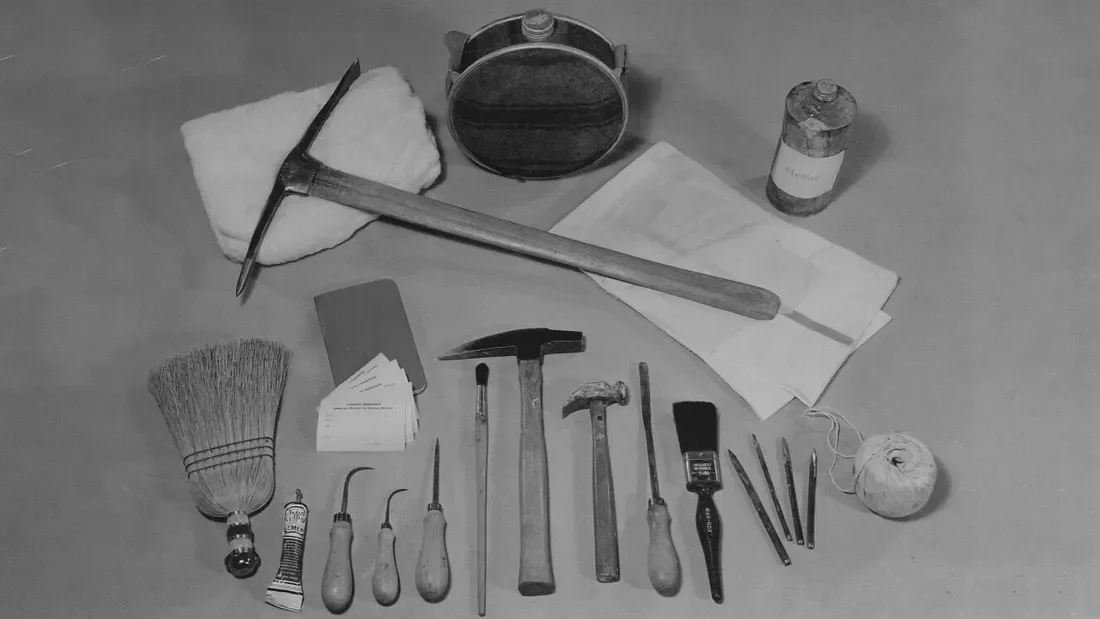
Early Fossil Preparation Tools. Credit: American Museum of Natural History (AMNH)
In 1903, Elmer S. Riggs invented the most important innovation in fossil preparation: air/pneumatic tools. These tools utilized compressed air and a fine-grained sand to blast away rock, preserving much more detail compared to hand tools. Modern fossil preparation uses pneumatic tools to preserve the finest details, which are particularly important for invertebrate fossils that are often only a few millimeters in length.
Today, while most museums have in-house lab facilities for fossil preparation, the tools necessary for exposing a fossil from its hard matrix are also widely commercially available. Outside of a select few museum staff, the vast majority of fossils are commercially prepared by experienced professionals and sold back to museums or into the hands of private collectors. Additionally, a significant number of amateur paleontologists and fossil hunters extract specimens from sites and engage in preparation themselves, oftentimes contributing their specimens to public institutions for the advancement of paleontology.
Most “museum-grade” fossils that are on display in exhibits or used as references in paleontological research are prepared with air scribes (a type of pneumatic chisel) or using acid washes. These methods erode the fossil’s limestone or shale matrix without coming into direct contact with the fossil itself, meaning that all the morphological details of the animal are kept.
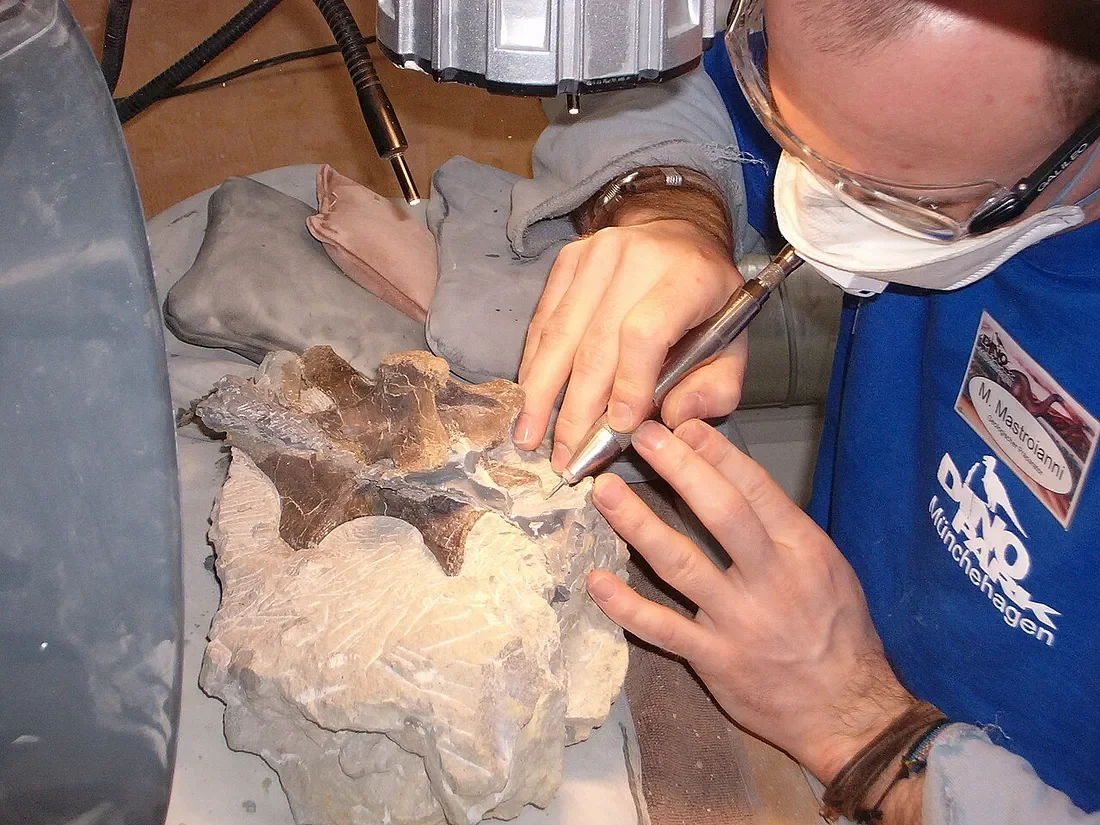
Modern preparation of a sauropod vertebrae using an air-scribe, microscope and lighting setup. Credit: Nils Knötschke
Sources Cited:
“Fossil Preparation Laboratories.” American Museum of Natural History, American Museum of Natural History, https://www.amnh.org/research/paleontology/collections/fossil-preparation/history/laboratories.
“History of Fossil Preparation.” American Museum of Natural History, American Museum of Natural History, https://www.amnh.org/research/paleontology/collections/fossil-preparation/history.
“Laboratories.” American Museum of Natural History, American Museum of Natural History, https://www.amnh.org/research/paleontology/collections/fossil-preparation/history/laboratories.
“Revealing: Techniques.” American Museum of Natural History, American Museum of Natural History, https://www.amnh.org/research/paleontology/collections/fossil-preparation/revealing/techniques.
“Staff.” American Museum of Natural History, American Museum of Natural History, https://www.amnh.org/research/paleontology/collections/fossil-preparation/history/staff.
“Techniques.” American Museum of Natural History, American Museum of Natural History, https://www.amnh.org/research/paleontology/collections/fossil-preparation/history/techniques.
“Tools and Equipment.” American Museum of Natural History, American Museum of Natural History, https://www.amnh.org/research/paleontology/collections/fossil-preparation/revealing/tools-equipment.
